
How Often Should a Dog Be Walked?

Understanding how often should a dog be walked is one of the most common questions dog owners ask. It sounds simple, but the answer depends on several factors, including your dog’s age, health, personality, and daily routine.
Regular walks are not just about exercise. They support your dog’s mental wellbeing, help prevent behavioural issues, and provide essential structure to their day. Whether you are adjusting a routine or starting fresh, getting this balance right matters.
For many owners balancing busy schedules, support such as dog walking and doggy day care services can help maintain consistency and ensure dogs still receive regular exercise and structured daily routines.
Why Daily Walks Are Essential for Dogs
Walking plays a central role in a dog’s overall health. It is not simply a routine task. It is a key part of how dogs experience the world.
Physical health
Daily walks help dogs maintain a healthy weight, support joint mobility, and reduce the risk of long-term conditions such as obesity and arthritis. Regular movement also strengthens muscles and improves cardiovascular health.
Mental wellbeing
Dogs rely heavily on their senses, especially smell. A walk provides mental stimulation through new scents, sounds, and environments. This kind of stimulation is just as important as physical activity.
Behaviour
Dogs that are walked regularly are often calmer at home. Without enough exercise, many dogs become restless, vocal, or destructive. Walking gives them an outlet for energy and natural behaviours like sniffing and exploring.

How Often Should a Dog Be Walked? General Guidelines
Most dogs benefit from at least one walk per day, but for many, two walks per day is a more suitable routine.
It is also important to understand that not all outdoor time is equal.
Walks vs toilet breaks
Dogs need multiple opportunities throughout the day to relieve themselves. For most adult dogs, this means being let out at least three to four times daily. However, these are not all full walks.
A good routine usually includes:
One or two proper walks
Additional short toilet breaks
Puppies and older dogs may need more frequent outings, but these are often shorter and less demanding.
What is “formal exercise”?
A proper walk is more than a quick trip around the block. It should allow your dog to:
Move at a comfortable pace
Sniff and explore
Engage with their environment
Consistency matters more than intensity. A predictable daily routine helps dogs feel secure and balanced.
What Affects How Often Your Dog Needs Walking
There is no one-size-fits-all answer. Several key factors influence how often your dog should be walked.
Breed and energy levels
Some dogs are naturally more energetic than others. High-energy dogs often need longer or more frequent walks, while lower-energy dogs may be satisfied with shorter outings.
However, breed is only a guideline. Individual personality always plays a role.
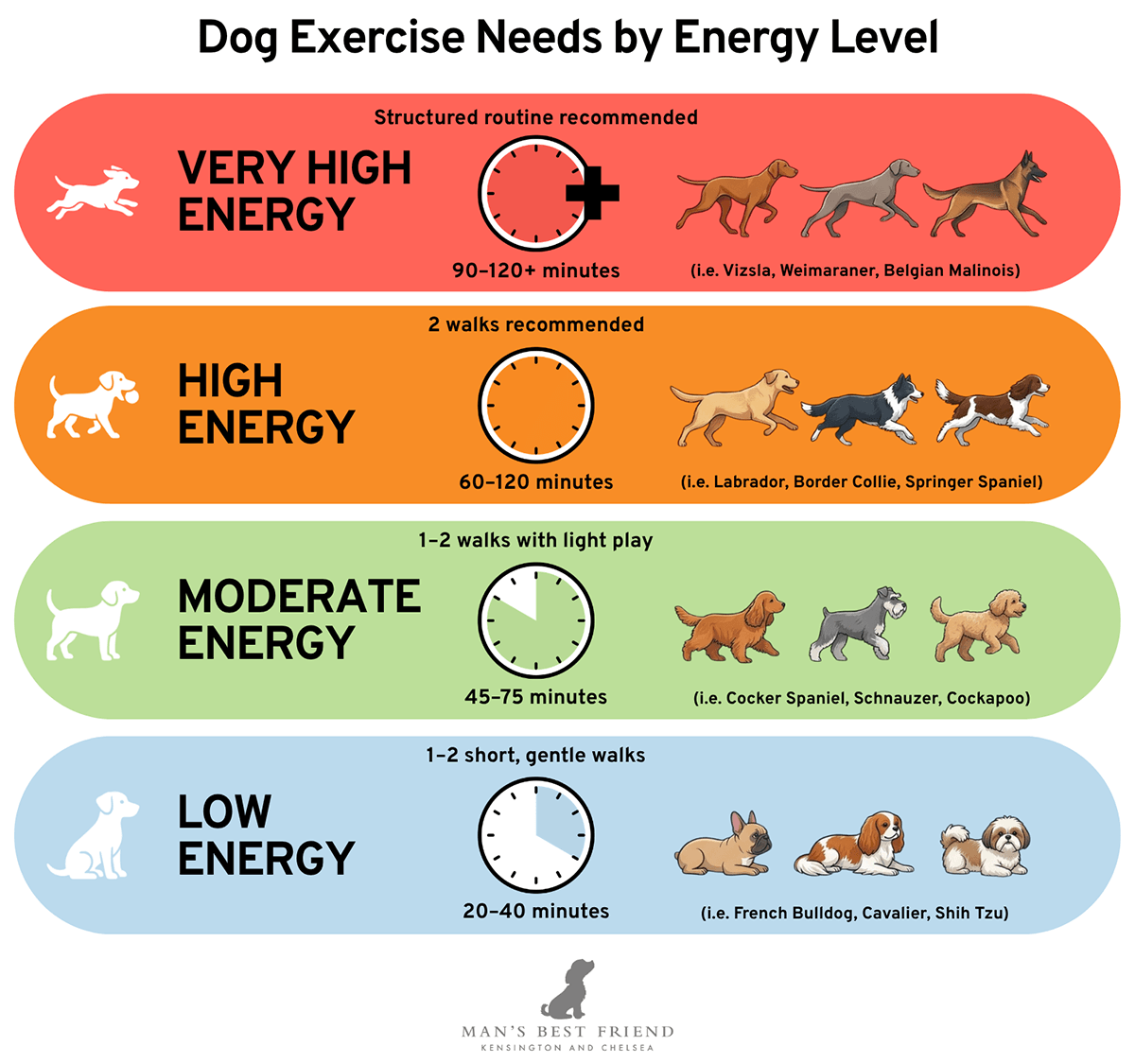
Dogs can be grouped broadly by energy level, which helps guide how often they should be walked. Low energy dogs, such as French Bulldogs or Shih Tzus, are usually content with 20 to 40 minutes of gentle walking each day. Moderate energy dogs, including Cocker Spaniels and Cockapoos, often need 45 to 75 minutes with a mix of walking and light play. High energy dogs, such as Labradors and Border Collies, typically require 60 to 120 minutes across two walks. Very high energy dogs, including Vizslas and Weimaraners, usually benefit from 90 minutes or more, alongside a structured daily routine.
Every dog is different, even within the same breed. Please remember:
Age, health, and fitness all affect exercise needs
Nervous or reactive dogs may need calmer, more controlled walks
Mental enrichment supports exercise but does not replace it
Age
A dog’s needs change over time.
Puppies
Puppies have plenty of energy but still-developing joints. A useful guide is around five minutes of structured exercise per month of age, done twice daily. Short, frequent walks are better than long ones.
Adult dogs
Adult dogs typically need the most exercise. Many benefit from one to two walks per day, depending on their energy levels.
Senior dogs
Older dogs may slow down, but they still need regular movement. Gentle, shorter walks help maintain mobility and mental stimulation without causing strain.
Health and fitness
Dogs recovering from injury or living with conditions such as arthritis may need shorter, more controlled walks. Fitness levels also matter. If your dog is not used to regular exercise, build up gradually.
Personality and preferences
Some dogs enjoy long, active walks, while others prefer a slower pace with plenty of sniffing. Paying attention to your dog’s behaviour will help you find the right balance.
Temperament: nervous, anxious, or reactive dogs
For nervous, anxious, or reactive dogs, walking routines may need to be adapted.
Rescue dogs or those still adjusting to their environment may find busy streets overwhelming. Reactive dogs may struggle with other dogs, people, or noise.
In these cases:
Shorter, calmer walks are often better
Quiet routes can reduce stress
Predictable routines help build confidence
These dogs still benefit from regular walks, but the focus should be on creating a sense of safety rather than increasing intensity.
Signs Your Dog Is Getting the Right Amount of Exercise
Understanding your dog’s behaviour is key to knowing whether their routine is working.
Signs your dog is getting enough exercise
Calm and relaxed at home
Healthy appetite
Good sleep patterns
Signs of too little exercise
Restlessness or pacing
Barking or attention-seeking
Destructive behaviour
Weight gain
Signs of too much exercise
Excessive tiredness
Limping or stiffness
Reluctance to walk
Signs walks may be too stressful
Increased anxiety after walks
Pulling, barking, or reacting strongly
Hesitation or refusal to go outside
In these cases, it is worth adjusting the environment, duration, or structure of walks.

What Counts as a “Good Walk”?
A good walk is not just about distance or speed. It is about quality.
Time to sniff and explore
Sniffing is a vital part of a dog’s experience. It allows them to process information about their surroundings and feel mentally satisfied. Rushing a walk can reduce this benefit.
Natural behaviours
Dogs use walks to:
Relieve themselves
Mark territory
Explore new scents
Allowing time for these behaviours helps make the walk more fulfilling.
Balanced activity
A well-rounded walk includes:
Movement
Exploration
Calm moments
For nervous or reactive dogs, a good walk may mean fewer triggers and a more controlled environment rather than busy social interaction.
What If You Cannot Walk Your Dog Enough?
Modern life can make it difficult to maintain a consistent walking routine.
Work commitments, travel, and daily responsibilities can all affect how often you are able to walk your dog. In these situations, having reliable support can help maintain structure and consistency.
Professional services such as dog walking can provide regular, structured outings when needed. You can learn more about this on the dog walking London service page.
The goal is always to ensure your dog receives consistent care, even when your schedule changes.
Exercise Alternatives for Bad Weather or Limited Mobility
There will be times when long walks are not possible. This might be due to weather, health, or mobility.
In these cases, mental stimulation becomes especially important.
Enrichment activities
Puzzle toys
Scent games
Short training sessions
These activities engage your dog’s brain and can help reduce boredom. However, they should support, not replace, regular walks whenever possible.
Building the Right Routine for Your Dog
The best walking routine is one that suits your individual dog.
Start with general guidelines, then adjust based on:
Energy levels
Behaviour at home
Response to walks
Gradually increase or reduce activity as needed. A consistent routine helps your dog feel secure and makes daily life more predictable.
Frequently asked questions
My dog does not like walks. What can I do?
If your dog is not enjoying walks, try to identify the cause. Fear, lack of fitness, or boredom can all play a role. Adjusting the environment, pace, or timing of walks can help. In some cases, professional advice may be useful.
How should I walk my reactive dog?
Reactive dogs benefit from calm, controlled walks. Choosing quieter times and locations can reduce stress. Focus on consistency and avoid overwhelming situations. The aim is to create a safe and predictable routine.
How much should I walk my arthritic dog?
Dogs with arthritis still need regular movement, but walks should be shorter and gentler. Avoid long or intense activity, and monitor for signs of discomfort. Speak to your vet if you are unsure.
How can I teach my dog to come when I call?
Recall training takes time and consistency. Start in a quiet environment and use positive reinforcement. Gradually introduce more distractions as your dog improves.
Can I just let my dog run in the garden?
A garden is useful, but it does not replace a walk. Walks provide mental stimulation, new environments, and opportunities for natural behaviours that a garden alone cannot offer.
How often should I walk my dog?
Most dogs benefit from at least one walk per day, with two being ideal. The exact frequency depends on age, health, and energy levels.
Will exercise stop my dog behaving badly?
Exercise can help reduce unwanted behaviours by providing an outlet for energy. However, it is not a complete solution. Training and routine are also important.